Lying-Flat Memes: Where Self-Deprecation Stops Being a Joke
In today's fast-paced work and daily grind, "lying-flat" memes have become a go-to outlet for young adults looking to blow off steam and decompress. A screenshot of a dozing cat or a languid cartoon character often sparks immediate resonance among friends. Yet, when creating and sharing these memes, many people overlook one crucial detail: a sense of occasion and context.
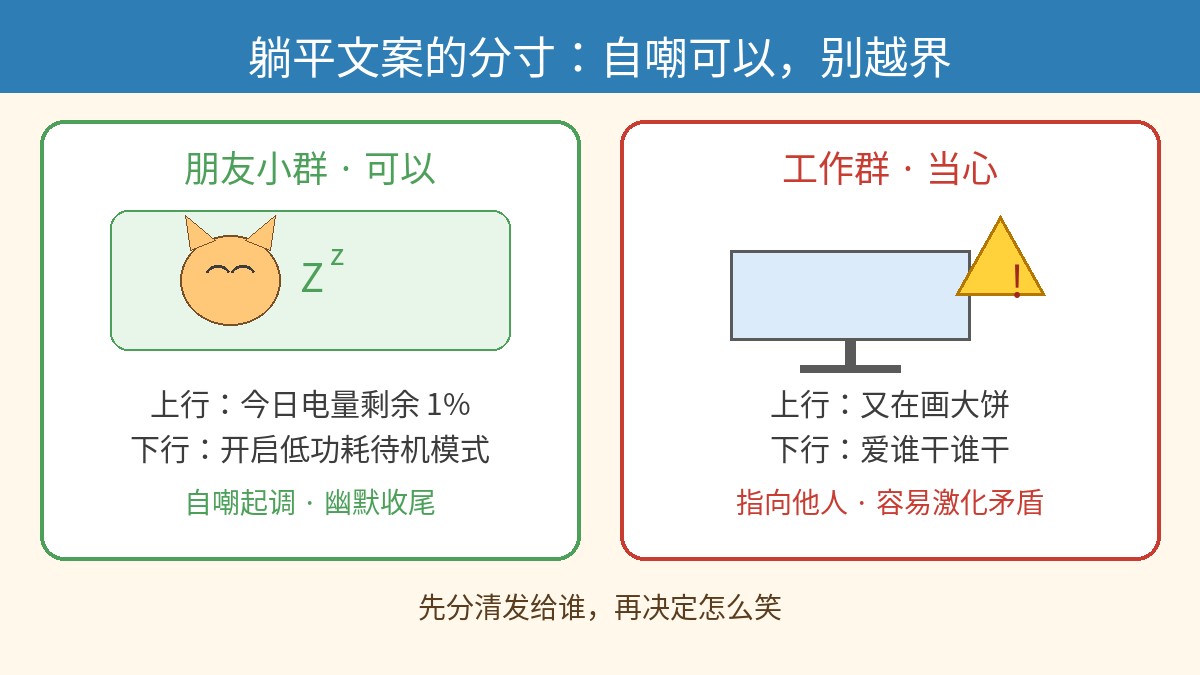
Self-deprecation is a healthy emotional relief valve. But without clear boundaries—especially when venting is disguised as a "joke" and dropped straight into workplace channels—it easily triggers misunderstandings and introduces unnecessary friction into team collaboration.
1. Defining Boundaries: The Emotional Divide Between Friend Groups and Work Chats
The exact same meme expressing burnout serves vastly different purposes depending on interpersonal dynamics:
- Private & Friend Chats: The core goals are "emotional resonance" and "authentic vulnerability." With higher psychological safety, casual venting or exaggerated declarations of "completely giving up" are recognized as jokes, quickly bringing people closer. - Work & Collaboration Chats: The core goals are "moving projects forward" and "delivering actionable information." In workplace communication, messages and memes carry implicit signals of commitment. Frequently posting resistance-heavy memes in team channels risks being interpreted by colleagues or leadership as passive-aggressive pushback or dodging accountability.
Before opening any meme generator, always ask yourself: who is your intended audience?
2. Avoiding Pitfalls: Shifting from Passive-Aggression to Playful Self-Deprecation
When crafting lying-flat memes, it is easy to slip into outright complaints or even finger-pointing. Effective copy keeps the spotlight firmly on poking fun at oneself, rather than deflecting blame or targeting others.
Compare these two approaches to see the shift in tone:
- Problematic Approach (Targeting others / aggressive venting): - Top Text: Another round of empty promises - Bottom Text: Do it yourself, I'm out - Breakdown: Directly hostile and loaded with negativity. Even as a casual quip, it easily stirs up workplace friction. - Adjusted Approach (Self-aware humor & relatable exhaustion): - Top Text: Physical body: clocked in on time - Bottom Text: Soul: reconnecting in the background - Breakdown: Acknowledges desk fatigue while diffusing the heavy mood through a playful tech metaphor.
The Core Principle: Open with self-awareness, close with humor. Let the top line state the reality of fatigue or pressure, and instead of spiraling into frustration on the bottom line, catch the sentiment with wit, contrast, or gentle self-mockery. The goal is to elicit a knowing smile, not drag down team morale.
3. Step-by-Step Guide: Crafting Well-Balanced Memes in 4 Easy Steps
Designing a restrained yet humorous meme doesn't require complex graphic design software; a clean, classic two-line layout is more than enough to land your message.
Step 1: Choose a Neutral or Endearing Base Image
Steer clear of characters with aggressive facial expressions or hostile gestures. Instead, choose harmless animals with slightly confused, zoned-out, or blank stares (like a yawning kitten or a daydreaming sloth) or clean, minimalist cartoon sketches. You can pick copyright-free templates from preset libraries or upload candid snapshots of your own pets.
Step 2: Set Up Top and Bottom Captions
The classic "top and bottom" meme format is naturally suited for emotional pacing: - Top Text: Sets the scene—e.g., "Battery remaining: 1%" - Bottom Text: Delivers the witty twist—e.g., "Entering low-power standby mode"
Step 3: Fine-Tune Typography and Layout
To make sure your text stays crisp and readable in mobile chat thumbnails: - Classic Stroke Style: White text with a black outline (or black text with a white outline) remains the gold standard, ensuring high contrast across any background. - Font Size & Alignment: Center-align by default, and manually scale the text box based on the template's negative space so you don't obscure key facial expressions. - Positioning: Fine-tune the text placement on the canvas. Keep the top line close to the upper edge and the bottom line near the bottom edge, leaving the focal point open in the center.
Step 4: Export and Run a Final Sanity Check
Once adjusted, export directly in PNG format. Most messaging platforms support standard square or common aspect ratios (check your target platform's latest specs for exact rendering). Before hitting send, run one final sanity check: If a colleague or stakeholder who doesn't know me well sees this, could it be misread as a poor work ethic? If so, save it for private chats with close friends.
4. In Short: Self-Deprecation Is a Pressure Valve, Not a Dart Thrown at Others
Memes are an indispensable lubricant in our digital lives. "Lying flat" is not the same as shirking responsibility; more often it is simply a worker's gentle way of telling peers, in a busy gap between tasks, "I'm pretty tired too." Master the measure of your caption — self-deprecate inward rather than complain outward — and humour can do what it is meant to do: heal.
If you want to make a self-deprecating meme that is both funny and appropriate, open meme.rapporteur.online and try the layout right away.
Open the meme maker
Choose a template or upload your own image, add top and bottom text, and export a crisp PNG. Your image is processed in your browser.